Friday, September 2, 2011

Do you remember?


Amy Bagley and Lydia Sargent
Taken abt 1945


Many years ago Lydia Tannahill Sargent wrote a remembrance to Amy Bagley, her sister, about some of the things that she remembered of their childhood.

”.........Do you remember the three plum groves in the pasture, how we ate and ate the plums and found out we could eat still more without making us sick?.........

..........Do you remember - Every evening we brought the cows in from the big pasture to the corral to milk?  I have a very fast moving picture in my mind of your (often) grabbing a cow by the tail as they came down the last hill into the corral.  How she would run but you hung on, if it nearly did snap your heels off!  And talking about cows!  We had gone to the corral to milk one evening, and you dared me  to sit down on a gentleman cow.  He was getting cross and we were both afraid of him.  He was lying down and I sat!  No animal ever moved so fast as he did and around that corral he run with me on his back!!!  I fell off as he neared the fence, and scooted under it!  I suppose he was as scared as I, …….and did you laugh! It scares me yet to think of it!........    

..........How we rode the pigs when we were quite small?  The pretty curly haired white Angora goat .. that was kept tied up so she couldn't chase us?  One day he got loose and when we saw her coming we made a "bee  line" for the nearest tree.  You're legs were longer and you reached it first and up it  you went and after you, as far as I could get, but she could reach my bare feet and butted them until our Mother rescued us.....”
 
 .........The poor old Ewe we took a dislike to - we waited until dusk and doused her in a pail of water. (I am still ashamed of this!).......... 

A cousin of mine still remembers visiting with us and going after the cows with my
brother Glen.  She remebers the playhouse that we had in the trees, with the "real framed picture" in it.  She was very impressed as she had never before seen a playhouse with a picture in it. 

......Do you remember - Our first doll, Rosie, a rag doll?   I recall the day we "gave her up" - a sad day, but Lucy and Ella soon took her place in our affections.  Our charm strings were an early interest in our childhood.   Remember the tree we climbed like squirrels?"........... 
  
......Do you remember the cart the folks got for us to ride to school in?  while playing at the barn one day we put the shafts up on a high stack, got into the seat and of course, it turned over backward, bumped our heads and doubled us up like jack knives..........”.


Saturday, August 20, 2011

Little family on the prairie


Lillian and Will's 1st home was a dugout on this timberclaim in Bellwood, Neb.  Amy and Lydia were born there and two years later they built a frame house and moved into it. This is Amy's memory of the dugout.Three children were born to this union, Amy Arvilla, Lydia Luella and Glen Ray. William and Lillian worked hard and loved their family. The children felt this and enjoyed their childhood. 


In the year 1879, on October 19, just in the midst of "Indian Summer, I was born  in small dugout on my father's timber claim.  This was up on the "table land" as it was then called.  This timber claim was in Butler Co., Nebraska.   My sister was born in the same dugout, 15 mos. later.    Long after, my parents told me that I could not remember the dugout, but I told them where the stove was in the middle of the room, the yellow clay floor and walls, the little room, where the bed set, and my trundle bed that went under that larger bed.  I even remembered my mother staying in that bed when my sister was born, although I was only 15 mos. old.  I told them where the one window 
Lydia and Amy Tannahill
was, with a wooden wash bench and always a pail of water and a wash basin.  I remembered very vividly the "thousand legged worms" that now and then invaded the place. They seemed to come suddenly from nowhere, and left just as suddenly.  I have never seen these worms since, but still remember them.  And when I  told my parents these things they were convinced that I remembered the dugout. 
Little beaded Indian purse
Amy continues,"How I loved it when, with my sister and I,  our  mother would go out in the pasture and gather up  "buffalo chips" to burn.  The buffalo trails were deep, narrow paths, going on and on  over the prairie, which was then rapidly being fenced into farms.  This  land was the old Indian campgrounds.  I never remembered the Indians coming to our doors, but used to hear others telling of these things.  While we were very young, the Indian stories and the howling of the coyotes made it very easy to keep us in the house after dark.  Sometimes the Indians would come and want to trade things.  I remember a beautiful little Indian purse that I wanted so much.  I told my father and he went to the Indians and traded something and that night brought me home my little purse.  I have kept that all my life

In 1881 they moved from the dugout into a little frame house that Will had built for his family.

Here is  a picture of that little house a few years later.  There is Lillian (Bowlsby) Tannahill and the little boy is her grandson, Marvin Ray with the dog named Spot.  Little Ray is Glen's son.


Saturday, August 13, 2011

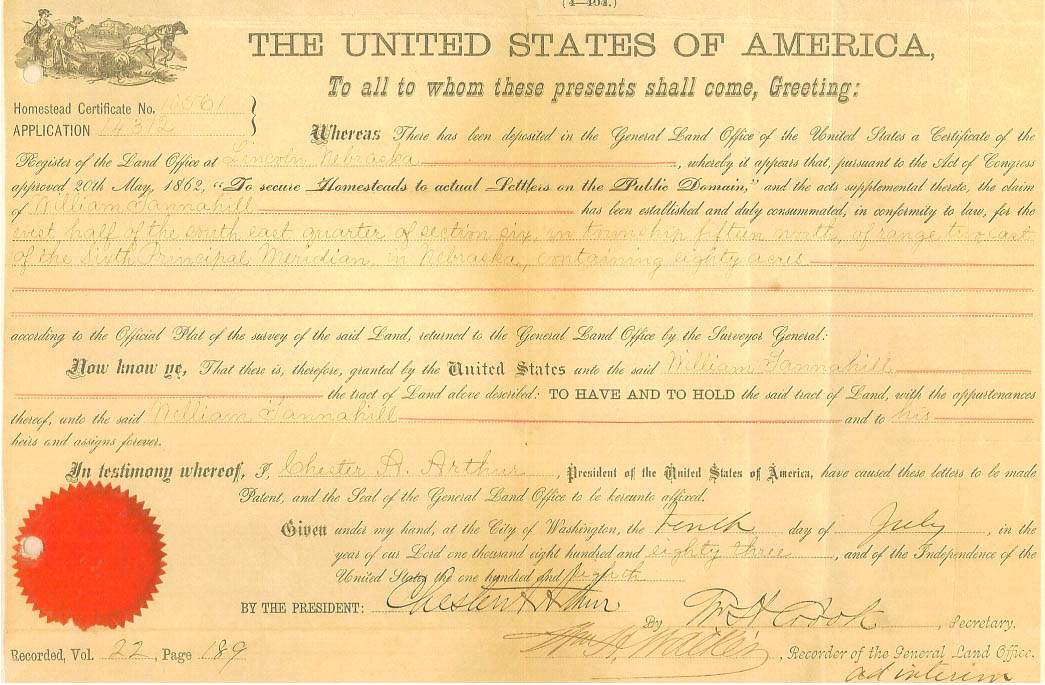
Lillian Rosalee Bowlsby marries William Tannahill

Mary Louisa Bowlsby Hall
Shortly after Josephine’s marriage, Mary Louisa married Isaac Hall, also in 1870.  They had three children, Mary Mellissa, Ada Mable and Mervin Eugene.
 It was with Louisa Hall that Lillian (her sister) went to live.  She was 18 yrs. old. She came in a covered wagon with them when they went to Nebraska.   She stayed with them until she married William Tannahill.  William Tannahill was the brother of John Tannahill who had married her older sister, Juliette Josephine, 9 years before.   
Lillian Rosalee Bowlsby
Here is a picture of Lillian Rosalee Bowlsby when she lived with her sister, Louisa.  

 Young Will Tannahill was 6 years old when the family moved to Iowa. William stayed in Canada with his grandparents, John and Jane Elder White.  He is listed as living in their household in the Census of Huntingdon in 1861.  He was 12 years old when his father died and when Janette applied for a Widow's Pension she lists William as "living in Canada".  There is no record of when he came to Iowa or if he ever did live there, but he must have come to visit his brother, John Tannahill and wife, Juliette Josephine (Bowlsby) in Nebraska because on the 31 Dec. 1878 (as recorded in the Book of Marriages, pg. 63, Butler Co., Nebraska), William Tannahill married Lillian. 
Her brother, Charles Edwin and his wife, Jennie were witnesses to the wedding along with Mary Louisa and Isaac Hall.

Will Tannahill


Wednesday, August 10, 2011

Juliette Josephine Bowlsby marries John Tannahill


Juliette Josephine married John Tannahill on Jan. 8, 1870 and went to live on a homestead in Butler, Nebraska.  Immediately after the wedding the happy couple started for Nebraska and the home that John had prepared for them.

  In the “History of Nebraska—Platte Co.,- Columbus” it has this to say about John. “He was a gardener, in present business in 1875.  He makes the seed business a specialty.  Mr. T. is a member of the American Legion of Honor, also of the G.A.R. Baker Post #9, and is at present the Post Commander of same.”

  John had a huge garden and orchard of small fruits and vegetables and whatever fruit was in season, and they sold to the stores and private homes uptown and were always back home for dinner with all sold.

  John and Josephine had 3 girls while in Nebraska, Lillian Annabell, b. Aug. 21, 1871, Jennie Melissa, b. June 20, 1874 and Minnie Louise, b. July 13, 1879.  All was well until July of 1882 when Josephine was drowned when she fell into a well that had been left uncovered.  Little Minnie was only 3 yrs. old.

.

Picture on right:   John Tannahill, Jennifer Melissa, Lillian Annabelle, Minnie Louisa on John's knee.  This is the little family that was left when Juliette was drowned.

Juliette's death notice:
The Columbus Democrat, July 29, 1882
TANNAHILL--Bad news, it is said, travels rapidly, and such was the case on Friday morning when the heartrending intelligence that Mrs. John Tannahill had been drowned during the night was spread through our city. Some time after midnight Mr. Tannahill was up, and his wife was then sleeping soundly. He returned to his bed, and on waking Friday morning his wife was absent from his side. He went down stairs and not seeing her he instituted search, going into the kitchen he discovered that the trap door of the cistern was out of its place, and looking down into it he was horrified to see the lifeless body of Mrs. Tannahill. He at once called together his neighbors, and the coroner was notified, an inquest was held, and the jury returned a verdict that she came to her death by drowning, and no one is to blame according to the evidence. The community extend to Mr. Tannahill heart-felt sympathy in his peculiarly sad bereavement. The loss of a loving wife is a terrible blow and the husbands grief is recognized in its fullest sense.

Find A Grave Memorial# 20253794
Tannahill, Juliette Josephine Bowlsby

Friday, August 5, 2011

What's in a name.


My grandmother, Lillian Bowlsby Tannahill, always said that her mother's name was Melissa Jane Thompson. but we never saw anything that could prove it.  As I started to search the census'. this is what I found.  In the 1850 Census for Butler County, Michigan I found this:
Here she is listed as Lucy.  Then in the 1860 Census I found this:
Here she is listed as Melissa J.  Then in the 1870 Census I found this:
Here she is listed as Jane.  So here was my conclusion, Melissa Jane Thompson was the right name.  I learned that you cannot only take one Census record.  You must check all of them because it seems like names change over the years.

She had Bowlsby relatives who lived nearby and would get together often with them. They also had Uncle Oscar Thompson who was Melissa Jane’s brother.   In the picture on the right, seated in the front is Uncle Oscar,  Lydia Luella is next to him.  Lillian is in the back. Irene and Glen Ray Tannahill complete the back row.


Sunday, July 24, 2011

James and the Railroad

Several years ago, my cousin, Marcia Loomis, found some notes that her father, James West Wilson, Jr., had in his effects.  He was one of three deaf boys who were the sons of James West Wilson.  When one of them had asked about what happened when he left Iowa, this is what he wrote:

He left home in Traer, Iowa in 1872 at the age of 22 and went to work for the Northern Pacific Railroad for three years.  While working for the railroad he was paid a wage of  $1.50 per day for one year; then $2.00 a day and then $4.00 a day.  He paid $4.50 a week for board and slept in a bunkhouse with hay as a mattress.  He often went to the tramp jungle (Railroad tramps who rode the rails).  At the tramp jungle, each tramp had his turn getting food for his fellow tramps, no matter where or how.  Many had to beg for food but the food was shared with all.  When it became James turn, he went to a restaurant and had a good breakfast of ham and eggs; then asked the waitress for the leftover garbage from the other tables to take over to the fellows at the tramp jungle.  The other fellows were amazed at how he could have gotten such good food, but he never told them how he did it.  The other railroad workers would blow their pay in bars while he saved and saved.  He never told anyone he was saving; otherwise he would have been robbed or killed.When he finally saved $1000, he moved to Missoula, Montana and started a business selling agricultural implements, wagons, plows, all kinds of machines, etc.  This he did for 15 years.  In 1887 he invested in real estate, houses for rentals and lots.

At the age of 42, James met a lovely young woman, Josephine Grant Prescott.  She was only 22 but they fell in love and were married.  When James was asked why he hadn’t married before that he said he hadn’t met anyone he wanted to marry. until then.

Wilson, James West
b. Aug. 24, 1849 d. Nov. 16, 1930 

Wilson, Josephine Grant Prescott
b. Aug. 9, 1868 d. Mar. 27, 1910 


Sunday, July 17, 2011

Young James West Wilson


James West Wilson was born in new London, Connecticut, soon after his parents arrived in this country from Scotland.  By the time he was 7 yrs. old his father had made the decision to settle in Iowa and in 1856 the family came to Iowa by wagon.  It was a hard journey but for a 7 yr old boy it was quite an adventure.  Within the next few years many of his Aunts and Uncles and Cousins had made the journey from Scotland to Iowa. West Wilson’s farm was in the center of the Scottish settlement at the intersection of well traveled main roads, in plain view of Tranquillity church.  The children knew the teams of everyone around and could keep track of the comings and goings of relatives and neighbors.

The children learned to herd cattle.  It was their job to keep the cattle away from unfenced crops.  Without doubt, all the children of that day had their turn at this wearisome,  never ending task.  While the cattle contentedly grazed, the children whiled away the long hours picking the friendly Johnny-jump-ups, wild crab apple blossoms, yellow buttercups, and red lilies; curling the  dandelion stems; gathering gum from the rosin weed; and making daisy chains.

Home in Iowa where James grew up.

They marked the nests of the quail, prairie chickens, and wild turkeys; played with young rabbits; watched ground squirrels, even crows and hawks; listened to the whistling notes of the meadow lark and the bobolink; found a chipmunk, sometimes a muskrat, or a beaver near the creek; avoided the skunks – and with it all kept their eyes on the cows.  James’ brother, Henry Lusk, tells this story, “In the early days, men all told snake stories.  As the age of the narrator increased, likewise did the size of the snakes.  A herder of twelve years, I never saw a snake that would measure seven feet.  My sister, Janet killed one seven  feet long but I did not see it.  She killed it with a gum weed, no sticks on the prairie.”

The young herders had many wolf stories.  Most of them were about the first severe winters the North Tama settlers spent in Iowa, when the wolves were desperate for food because of the deep snow.  They gathered in large droves, howled constantly, prowled around the buildings so that it was unsafe to step outside a cabin door after dark.  One settler, looking out over a howling pack, seized a rifle, raised a window enough to take aim and shot a wolf, thinking it would frighten the others away; but the rest of the wolves, wild at the scent of blood, fell upon the carcass in a frenzy “and literally rent it to pieces, devouring everything but the tail and skull.  Then another wolf was shot.  This slaughter continued until the appetites of the wolves were appeased and the survivors retreated to their dens.  In about a week the pack would be back for another feast and the shooting was repeated.  This kept up until the snow disappeared.”
  
When James was 11 yrs. old, his mother, Margaret Drynan Wilson died, leaving nine children.  His older sister, Janet, was only 14 yrs. old, next were twin sisters, Margaret and Jane, who were 12 yrs. old, then James West,  Agnes, 8 yrs. old, Catherine, 6 yrs. old, William Drynan, 4 yrs. old, Henry Lusk, 2 yrs. old and the baby, Grace who had been born 2 months before their mother died.  Grace only lived three years.  It was during this time that  their Aunt Margaret would come over to watch over the children.  Many times, during the winter months, she would have the children stay in bed to keep warm.  After the death of baby Grace, West began to write back to Scotland to a girl he had known years before.  It wasn’t long before they decided to get married and Barbara Kennedy boarded the ship bound for America. 

Sources for this story:   "They Came to North Tama" by Murray and "My Pioneer Wilson Story" by Dalton K. Wilson